Travel Allied Health: Navigating Licensing Rules
Travel allied health licensing involves meeting rigorous, state-specific professional requirements for practice across diverse jurisdictions. This crucial process ensures healthcare professionals like physical therapists, occupational therapists, and radiologic technologists maintain legal standing and uphold patient safety standards. It directly allows them to pursue various assignments nationwide, providing the flexibility essential for a dynamic travel allied health career, often requiring both state specific allied health licenses and an understanding of compact licenses allied health for multi-state practice.
Key Characteristics of Allied Health Licensing:
Jurisdictional Variation: Each state board sets unique requirements for application and renewal.
Application Complexity: Processes involve specific documentation, varying fees, and different timelines.
Interstate Compacts: Emerging agreements, such as the Physical Therapy Compact, simplify interstate licensure allied health for certain professions.
Ongoing Compliance: Licenses demand continuous management, including renewals and state-mandated Continuing Education Units (CEUs).
Successfully navigating these varied travel allied health licensing requirements largely determines a professional's career mobility and income potential. Many allied health travelers frequently find themselves managing multiple individual licenses simultaneously, a significant administrative burden and time investment. This directly impacts their ability to secure desired assignments and respond quickly to staffing needs.
This guide breaks down the complexities of allied health licensing, offering a clear framework for understanding state-specific rules and emerging compacts. By the end, you will confidently approach licensure management, maximizing your career opportunities without bureaucratic headaches.
Understanding Allied Health Licensing & Compacts
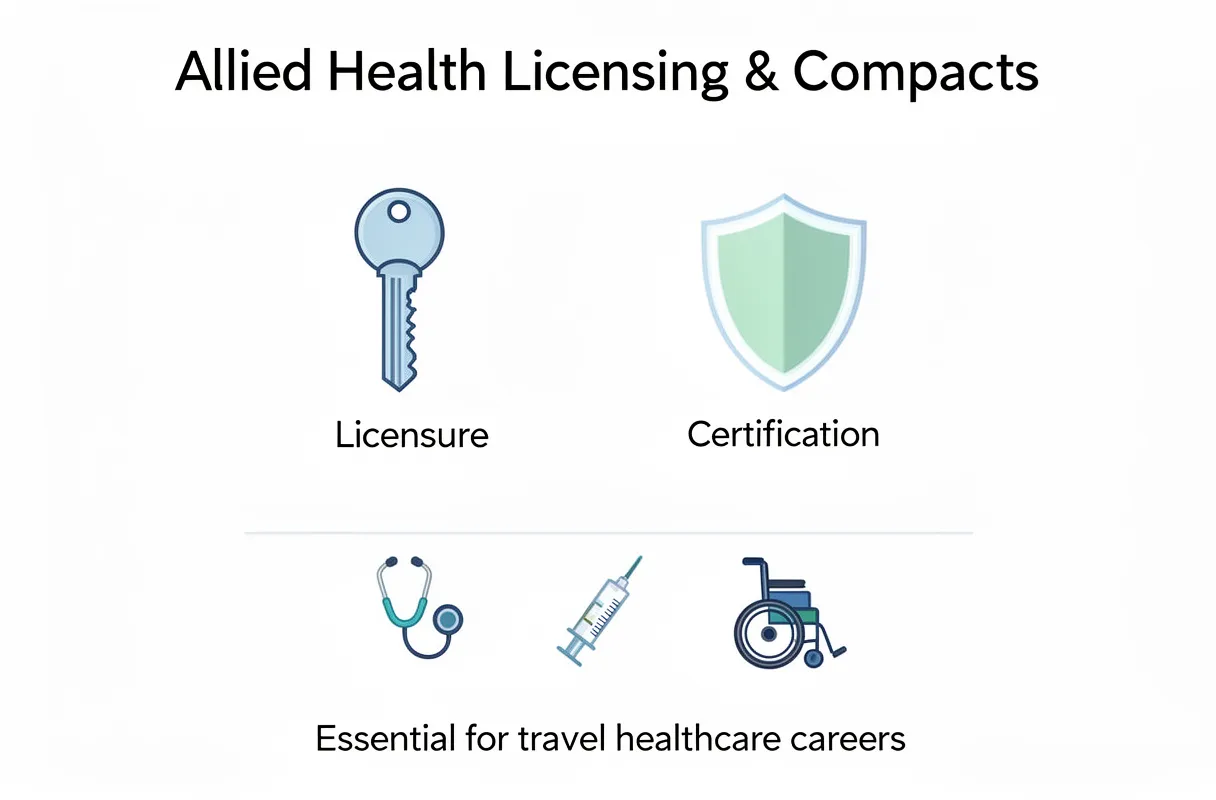
Allied health licensure and certification establish professional standards and ensure competency. State licensure grants permission to practice within a specific state, while national certification validates skills across the country. Both are essential for travel allied health professionals to work legally and competently.
General prerequisites for starting a travel allied healthcare career include obtaining the required state licensure requirements and passing a national certification allied health exam where applicable. Understanding these foundational elements is the first step to a successful travel career.
Key Takeaways:
State licensure is geographically specific; national certification is broadly recognized.
Both are non-negotiable for travel allied health roles.
Understanding state licensure allied health is paramount for practicing legally.
What Are Allied Health Interstate Compacts?
Allied Health Interstate Compacts are formal agreements between states. They allow licensed professionals to practice in multiple member states under one primary license. This concept, often referred to as having compact licenses allied health, streamlines interstate licensure allied health practice.
Think of it like a universal driver's license. Instead of needing a separate license for every state you drive in, one compact license lets you practice across many. For allied health professionals, this means potentially avoiding multiple state-specific applications and fees.
Currently, robust multi-state compacts for many allied health professions are limited. The Physical Therapy Compact allied health stands out as a well-established model, allowing physical therapists to practice in participating states with a single license. However, similar comprehensive compacts for professions like Occupational Therapists, Respiratory Therapists, or Radiologic Technologists are largely absent or in early development stages. This leaves many allied health travelers needing to secure individual state licenses. For an authoritative overview of multi-state licensing compacts in healthcare, consult multi-state licensing compacts. While successful models like the Nurse Licensure Compact (NLC) and Interstate Medical Licensure Compact (IMLC) exist, they cater to nurses and physicians, not the broader allied health field. This gap presents a significant hurdle for allied health professionals seeking national mobility.
Navigating State-Specific Allied Health Licenses
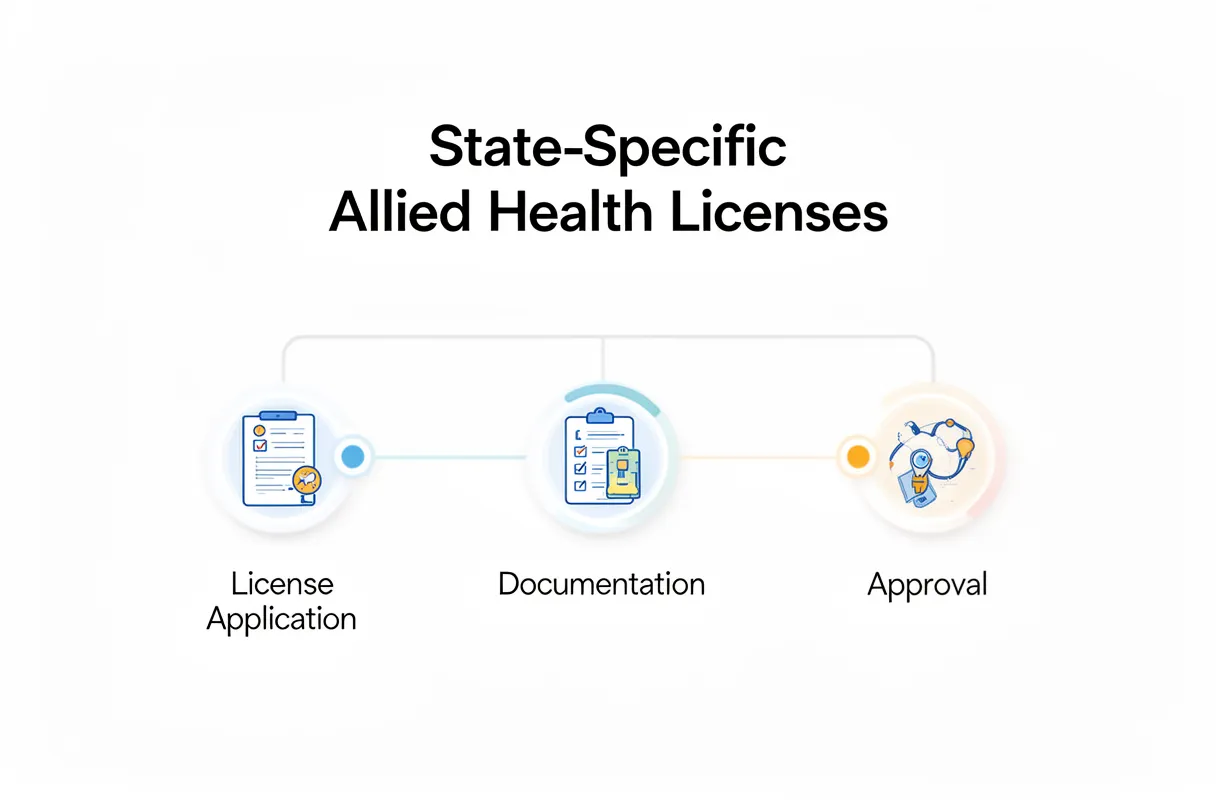
Many travel allied health professionals still rely on individual state specific allied health licenses for practice. This means understanding and managing the complexities of licensing in each location you work.
The allied health licensure process for individual states involves several steps. You'll typically need to gather documentation like proof of education, examination results (e.g., national certification scores), and verification of previous licenses. Application timelines can vary significantly, sometimes taking weeks or even months. Be prepared for associated fees, which differ by state and profession.
Typical Documentation:
Official transcripts
National certification verification
Background check results
License verification from other states
Application fees
Renewal processes also require attention. Most states mandate continuing education units (CEUs) to maintain an active license, with specific hour requirements and topics often dictated by the profession. It's wise to stay organized and track your CEUs throughout the licensing period.
Reciprocity agreements allow a licensed professional in one state to obtain a license in another state without fulfilling all the initial requirements. However, these agreements aren't universal and depend on the specific states involved. For a comprehensive understanding of health professional licensure and reciprocity agreements, consult health professional licensure.
Profession | Typical Timeline | Estimated Fee Range | Renewal Frequency |
|---|---|---|---|
Physical Therapist | 4-8 weeks | $150 - $300 | Biennial |
Occupational Therapist | 6-10 weeks | $100 - $250 | Biennial |
Respiratory Therapist | 3-6 weeks | $75 - $200 | Annual/Biennial |
Radiologic Technologist | 4-7 weeks | $100 - $250 | Biennial |
Telehealth allied health licensing adds another layer. If you provide services remotely, you generally need a license in the state where the patient is located, as well as your own state of practice. This can mean holding multiple licenses to serve a wider client base.
Overcoming Bureaucratic Hurdles in Travel Allied Health
The sheer volume of paperwork and varying state requirements for allied health licensing presents a significant bottleneck for travelers. Navigating allied health licensing challenges means confronting a bureaucratic maze designed for individual state practices, not rapid multi-state mobility.
Problem: Inconsistent Application Platforms & Processes
Each state board uses different online portals, often with clunky interfaces.
Requirements for documentation (e.g., verification of education, fingerprinting, background checks) differ wildly.
Some states require physical mailings, others are entirely digital.
Solution:
Start Early: Begin license applications at least 3-4 months before your target start date.
Centralized Record Keeping: Maintain a secure digital folder with scanned copies of all your credentials, licenses, CEU certificates, and transcripts.
Credentialing Services: Consider using a professional service that specializes in healthcare licensing. They navigate the bureaucracy for a fee.
Problem: Extended Processing Times & Delays
Processing can take anywhere from 2 weeks to 4 months, with little to no recourse for speeding things up.
"Hold" periods for background checks or license verifications are common and opaque.
Incomplete applications are routinely returned, restarting the clock.
Solution:
Understand State Board Nuances: Research each state's specific processing times and common pitfalls. Some boards are notoriously slow.
Proactive Follow-Up: If you haven't heard back within the expected timeframe, politely follow up via email and phone.
Leverage Agency Support: Your staffing agency's credentialing team can often advocate on your behalf with state boards.
Problem: Varying Continuing Education (CEU) Requirements
CEU types, hours, and renewal periods differ significantly across states.
Tracking these varied requirements for multiple licenses is a significant administrative burden.
Solution:
"Home State" CEUs: Focus on meeting the CEU requirements of your primary state of licensure. Often, these will satisfy others.
Bulk CEU Courses: Take courses that offer broad applicability or multiple CEU credits to efficiently meet requirements.
The hard truth is that travel allied health bureaucracy demands meticulous planning and patience. Managing multiple state licenses requires an organized, proactive approach to avoid career-disrupting delays.
Strategic Planning for Your Travel Allied Health Career

Strategic planning for your travel allied health career means proactively managing your licensure to maximize flexibility. You must decide on a principal licensure allied health state, which acts as your home base. This decision impacts your ability to work across state lines efficiently, whether through compact agreements or by managing multiple individual licenses.
Choosing your home state involves weighing pros and cons. A compact state offers easier multi-state practice if your profession is included. However, even without a compact, a strategically chosen non-compact state might offer benefits like lower taxes or a simpler renewal process. This choice forms the bedrock of your multi-state allied health strategy.
Here's a comparison of strategic home base scenarios:
Scenario | Allied Health Role Examples | Pros | Cons |
|---|---|---|---|
Compact State Home Base | RN, PT, OT, RT, SLP (if profession compact-enabled) | Easier multi-state practice within the compact. Streamlined initial licensing. | May limit flexibility if your desired assignments are outside the compact. Specific state requirements still apply. |
Non-Compact Home Base | Many Allied Health (e.g., Rad Tech, MLS, MA) | Freedom to choose any state as home base. May offer lower state income tax. | Requires obtaining individual licenses for each state of practice. More complex renewal process. |
Selecting your primary state of licensure is a foundational step. Your home state allied health license will be the primary one you maintain. From there, you build your strategy for other states, considering job market demand and personal financial goals.
Finding Allied Health Jobs Aligned with Your Licenses
When you’re hunting for travel allied health jobs, the quickest way to find relevant opportunities is to match them against your existing licenses. Many allied health professionals, from Radiologic Technologists to Medical Laboratory Scientists, juggle licenses across multiple states. Your goal is to streamline this search so you see positions where you can start working fast, or where the licensing hurdle is manageable.
Using the right tools cuts down the search time significantly. You need a platform that allows you to immediately filter assignments based on your licensure. This means looking for job boards that offer granular search capabilities beyond just state and specialty.
Our platform, MedNomadJobs, helps you pinpoint finding allied health contracts that fit your licensing profile. We aggregate opportunities from vetted staffing agencies, allowing you to browse and compare transparent pay packages side-by-side.
Here’s how we simplify your allied health job search tools:
Filter jobs by your current state specific allied health licenses.
Identify roles in states covered by your compact licenses allied health.
Compare full, transparent pay packages side-by-side for accurate budgeting.
Set up free job alerts to get notified of new matching assignments daily or weekly.
Apply directly to contracts without hidden fees or intermediaries.
This focused approach saves you the frustration of discovering a dream job only to find out you’re months away from obtaining the necessary license. It allows you to efficiently explore current travel allied health opportunities that align with your licensing status.
Essential Licensing Resources for Allied Health Professionals
Finding accurate allied health licensing resources is non-negotiable for any travel professional. State boards update requirements frequently, making direct access to official information essential. You need to know exactly where to look for the most current rules and application processes.
You can find official state board contact information by searching for the specific allied health profession followed by the state name (e.g., "Physical Therapy Board of Texas"). These official sites are your primary source for application forms, fee schedules, and specific practice act details. For quick reference to opportunities in states with unique rules, check out our listings for travel allied health jobs California.
Here's how to efficiently locate the necessary resources:
State Licensing Boards: Each state has a board that oversees the licensing of healthcare professionals. A simple web search for "[your profession] + [state name] + licensing board" will typically lead you to the correct government portal. These sites detail renewal requirements and disciplinary actions.
National Professional Associations: Organizations like the American Physical Therapy Association (APTA), American Occupational Therapy Association (AOTA), and American Society of Radiologic Technologists (ASRT) often provide comprehensive licensing guides. They also offer updates on legislative changes that could impact your practice.
Compact Licensure Information: If you are in a state that participates in a professional licensure compact, consult the official compact website. This can streamline obtaining licenses in other compact states. Always verify compact status for your specific profession.
Always cross-reference information found on association sites with the direct requirements of the state board where you intend to practice. Requirements can change without notice. Staying proactive with these allied health licensing resources ensures you remain compliant and ready for your next assignment.
Ready to find your next healthcare travel contract?
Browse curated healthcare travel jobs with transparent pay packages.
Browse Healthcare Travel Jobs